.png)
Food Assistance Stress in the United States and the Risks of Systemic Breakdown
A MW42 special study on U.S. food assistance stress and the Syria collapse as a analogue.
Summary
This report focuses on the most recent U.S. reporting and releases available in roughly the last
two months, especially official releases from March through May 2026, and then uses older primary sources where necessary for the historical case study. The Summary is that the United States is experiencing a real and measurable affordability squeeze that is pushing more households toward food pantries, meal programs, and other charitable food sources. The data does not support a claim that near-term nationwide societal collapse. They do support a conclusion that the country is vulnerable to a rolling food-and-affordability stress cycle in which higher grocery costs, housing burdens, household debt strain, and tighter safety-net access reinforce one another and overload local relief systems. [S01][S02][S03][S04][S07][S08][S12][S13]

A relevant modern historical analogue is Syria’s pre-2011 agrarian and governance breakdown that cascaded into state fragmentation and long-run social collapse. Syria is the best fit because it combined a severe food-production shock, rural livelihood destruction, budget and subsidy strain, distrust in governing institutions, coercive repression, and regional geopolitical spillover. The point of the analogy is pathway similarity, not equivalence: the United States has much greater institutional depth, fiscal capacity, domestic food production, and financial intermediation than pre-war Syria. That is exactly why a Syria-style outcome is not the most likely U.S. scenario even though several early-stage stress mechanisms are visible now. [S15][S16][S17][S18][S20][S21][S22][S23]
Current U.S. Stress Picture
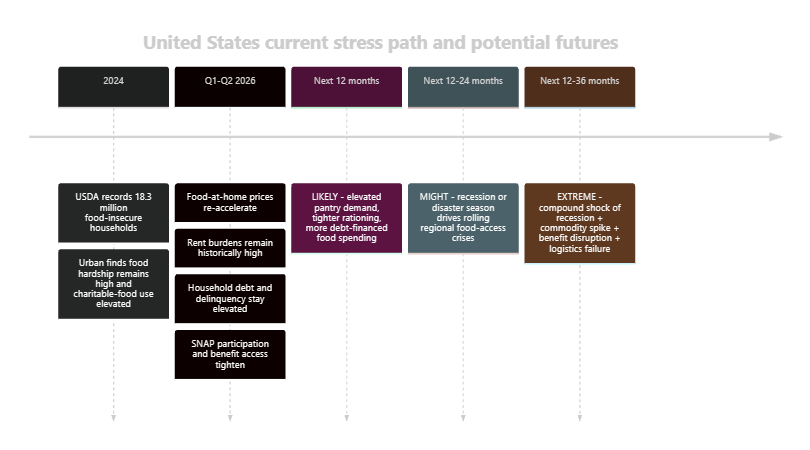
The latest federal annual food-security release shows that 13.7 percent of U.S. households, or 18.3 million households, were food insecure at some point in 2024, while 47.9 million people lived in food-insecure households. Among households with children, 18.4 percent were food insecure in 2024, and in 0.9 percent of households with children, at least one child experienced reduced food intake and disrupted eating patterns. These are not fringe numbers; they describe a large national population already operating with thin margins. [S01]
Recent nonfederal but high-quality survey work shows why food-pantries remain under pressure even when the labor market has not outright collapsed. Urban Institute research reported that in December 2024, more than one in six nonelderly adults said their household had received free groceries or free meals, and that households were turning to food pantries and meal programs more often than before the pandemic and the recent food-price spike. In a separate March 2026 brief, Urban found that more than half of working-age adults in low-income families reported food insecurity in 2025, and that food insecurity also rose among moderate-income households, suggesting the problem is no longer confined to the poorest households. [S02][S03]
The price backdrop remains punishing. In the Bureau of Labor Statistics’ April 2026 CPI release, the food-at-home index rose 0.7 percent in one month and 2.9 percent over the prior 12 months; fruits and vegetables were up 6.1 percent year over year, and the broader food index was up 3.2 percent. Shelter inflation remained elevated at 3.3 percent year over year, while overall CPI rose 3.8 percent. At the same time, BLS reported that the labor market was softer but not collapsing: unemployment was 4.3 percent, 7.4 million people were unemployed, and 4.9 million were working part time for economic reasons. Real earnings were not keeping pace comfortably either: BLS reported that real average hourly earnings fell 0.3 percent from April 2025 to April 2026. [S04][S05][S06]
Housing and debt are acting as force multipliers. Harvard’s Joint Center for Housing Studies reported in 2025 that 22.7 million renter households were cost burdened in 2024, meaning they spent more than 30 percent of income on rent and utilities, and 12.1 million were severely cost burdened, spending more than half.
The New York Fed’s May 12, 2026 household debt release found that total household debt reached $18.8 trillion in Q1 2026; 4.8 percent of outstanding debt was in some stage of delinquency; credit-card balances were $1.252 trillion; and the flow into serious delinquency on credit cards reached 7.10 percent. When food, rent, utilities, and debt service rise together, food is one of the easiest line items to cut or defer, which is exactly how households end up moving from “getting by” to pantry dependence. [S07][S08]
The near-term food-price outlook has not normalized enough to relieve that pressure. USDA’s ERS April 2026 Food Price Outlook forecast 2.9 percent inflation for all food in 2026 and 2.4 percent for food at home, with some especially relevant categories projected much higher, including beef at 6.3 percent, fresh vegetables at 4.8 percent, sugar and sweets at 8.1 percent, and nonalcoholic beverages at 5.2 percent. On the global side, FAO reported that its April 2026 Food Price Index rose for a third consecutive month, while the World Bank’s April 2026 Commodity Markets Outlook warned that energy prices were projected to surge 24 percent in 2026 and overall commodity prices 16 percent, with fertilizer costs also rising sharply. That matters domestically because U.S. grocery prices are strongly exposed to fuel, fertilizer, feed, freight, and packaging costs even when the U.S. remains a major agricultural producer. [S09][S10][S11]
Policy changes are adding a second wave of pressure. In an AP fact-check published two weeks ago, reporters noted that about 4.3 million fewer Americans were receiving SNAP benefits in January 2026 than in January 2025. Separately, CBO’s August 2025 supplemental analysis estimated that the work-requirement changes in Public Law 119-21 would reduce SNAP participation by roughly 2.4 million people in an average month over 2025–2034, while other provisions would lower benefits for portions of participating households. Feeding America’s May 2025 national report warned that if SNAP benefits or eligibility are reduced, more people will likely experience food insecurity and need more help from food banks and pantries, and it estimated that more than 50 million people received charitable food assistance at some point in 2023. That combination—less effective purchasing power plus more reliance on charity—is the core mechanism behind today’s elevated pantry demand. [S12][S13][S14]
A Historical Analogue
A relevant historical event for the current U.S. conversation is Syria’s transition from pre-2011 agrarian and welfare stress into social breakdown, civil conflict, and long-duration economic collapse. The reason this is the strongest analogue is not that the United States resembles Syria in power, wealth, or institutions. It is that Syria demonstrates how food insecurity becomes politically explosive when it arrives together with rural asset loss, weakening state legitimacy, rising household grievances, subsidy strain, and coercive state response. [S15][S16][S18][S20][S21]

The stress sequence was visible before the war. FAO reported in 2008 that poor rainfall since October 2007 had produced the worst drought in Syria in four decades, that approximately one million people were severely affected and food insecure, and that during the 2007–2008 planting season nearly 75 percent of vulnerable rainfed households suffered total crop failure. In 2009, FAO reported that Syria was facing its third consecutive year of severe drought and that the crisis had negatively affected the food security of 1.3 million people, including more than 800,000 severely affected. [S15][S16]
Researchers have argued for years about how much of the Syrian collapse should be

attributed to climate and how much to governance. The best-supported reading is that both matter, but governance and policy determined how destructive the drought became. Kelley and coauthors argued in PNAS that the 2007–2010 drought was the worst in the instrumental record and contributed to the conflict. At the same time, Jan Selby’s Cambridge work argued that government policies and long-standing environmental and agrarian vulnerabilities were at the heart of Syria’s exposure, and not climate alone. A World Bank agricultural study published before the war also documented how central subsidies were to the Syrian rural economy: subsidized diesel fuel alone accounted for 2.6 percent of GDP, and the cotton price subsidy another 0.9 percent, even as declining oil exports made those supports harder to sustain. [S17][S18][S19]
The turning point came when socioeconomic stress met repression. Human Rights Watch documented that protests in Daraa began in March 2011 after schoolchildren wrote anti-government graffiti, and it concluded that systematic killings and torture by Syrian security forces in Daraa after protests began on March 18, 2011 strongly suggested crimes against humanity. In other words, food stress and livelihood loss did not mechanically “cause” collapse; rather, they loaded the system with grievance, and the state’s answer to mass grievance was violent repression, which destroyed the possibility of peaceful adjustment. [S20]
The long-run consequences were catastrophic. The World Bank estimated that by 2017 the war had caused more than 400,000 deaths, forced over half the population from their homes, and pushed about six in ten Syrians into extreme poverty. By 2024, the World Bank said poverty affected 69 percent of the population and extreme poverty 27 percent, while UNDP reported in 2025 that Syrian GDP by the end of 2024 was more than half below its pre-conflict level, that cumulative lost GDP since 2011 was about $800 billion in 2010 prices, and that inflation had increased roughly 200-fold over the conflict period. Even after the front lines cooled relative to earlier years, the country remained structurally brittle: in May 2026, WFP said it had cut emergency food assistance in Syria by 50 percent, reduced coverage from all 14 governorates to seven, and halted a nationwide bread subsidy despite 7.2 million people still being acutely food insecure. [S21][S22][S23]
Comparison and Compounding Pressures
The Syria case suggests a general collapse pathway: food-cost or food-supply shock → household budget crisis → asset depletion and charity dependence → political grievance and distrust → state or institutional failure to absorb the shock → wider breakdown. In Syria, every step in that chain occurred. In the United States today, the first three steps are visible in the data, while the latter steps remain risks, not baseline realities. [S15][S16][S20][S01][S02][S07][S08]
The strongest current U.S. analogues to Syria’s pre-collapse pressures are these.
First, there is an affordability shock: food-at-home prices are rising again, rent burdens remain at record levels, and debt delinquency is elevated.
Second, there is buffer erosion: real pay is not clearly outrunning essentials, more people are working part time for economic reasons, and low-income households are reporting food insecurity at extremely high rates.
Third, there is safety-net tightening: recent SNAP changes are reducing participation and in some cases lowering benefits, which pushes demand outward from federal entitlement programs to charities and local mutual aid.
Fourth, there is a geopolitical cost channel: FAO and the World Bank both show that international energy, fertilizer, and commodity shocks remain capable of transmitting quickly into food affordability. [S04][S05][S06][S07][S08][S03][S12][S13][S11][S10]
There is also a social and political multiplier. Gallup reported in late 2025 that Americans’ trust in the federal government to handle domestic and international problems remained near five-decade lows, and that broader confidence in major U.S. institutions also remained near record lows. Low trust does not itself create hunger, but it reduces adaptability: it makes consensus on emergency policy harder, slows coordination, and increases the odds that people read scarcity through a partisan or conspiratorial lens rather than a problem-solving one. In Syria, the decisive escalation occurred when socioeconomic grievance met coercive politics. In the United States, a comparable trigger would be not ordinary inflation, but a compound event in which economic stress, administrative disruption, and political paralysis arrive together. [S24][S25][S20]
The biggest difference, and the main reason this analysis does not suggest national U.S. collapse to be likely, is structural. The United States still has a continental food-production base, nationwide logistics networks, broad credit markets, and federal transfer mechanisms that operate at a vastly larger scale than Syria’s pre-war system.
Comparison and Compounding Pressures
That is an inference from the current U.S. evidence on national employment, household credit, federal food assistance, and food-price administration. So the more realistic U.S. risk is not “overnight national collapse”; it is persistent degradation, with some communities experiencing local stress conditions before the country as a whole does. [S05][S08][S01][S09]
Scenario Outlook
The threshold question is not whether a single indicator worsens. It is whether several stressors worsen at the same time. The current data already show a system vulnerable to compounding shocks: elevated food insecurity, renewed grocery inflation, extreme rent burden, heavier debt stress, and program retrenchment are all present simultaneously. [S01][S03][S04][S07][S08][S13]
What is likely to happen. The most likely path over the next 12–24 months is a prolonged hunger-and-affordability squeeze, not collapse. That would mean pantry demand stays high or rises modestly, food banks and meal programs ration more tightly, more working households cycle between wages, debt, SNAP if eligible, and charitable food, and hardship remains disproportionately heavy for households with children, disabled adults, and low-income renters. In this scenario, the system still functions, but it functions more expensively, more unevenly, and with higher social strain. [S01][S02][S03][S07][S08][S04]
What might happen. A plausible but less likely path is rolling regional stress. This would require one additional hit on top of current conditions—a recession, a damaging disaster season, another leg up in fuel or fertilizer prices, or more aggressive reductions in food-assistance purchasing power. In that case, some localities would experience temporary pantry stockouts, sharply longer lines, more school and campus emergency feeding, municipal emergency appropriations, and intermittent local unrest around scarcity or service failures. The key point is that this would probably look uneven and geographic, not like uniform national collapse. [S11][S10][S09][S13][S24]
What the extreme case could be. The extreme but low-probability path is a compound systems shock: recession plus a commodity spike plus a significant interruption or administrative disruption in benefits or food-distribution payments plus a major logistics or disaster shock. That is the kind of bundle that can produce short-lived but severe SHTF-style conditions: panic buying, local store stockouts, overwhelmed pantries, spikes in petty crime and conflict, and visible deterioration in local public order. The Syria lesson is that collapse is rarely caused by one variable; it happens when multiple buffers fail in sequence. The U.S. is still far from Syria’s 2011 threshold, but the current U.S. data show that household buffers and charitable-system buffers are already thinner than many policymakers appear to assume. [S15][S20][S23][S11][S04][S08]
Open Questions and Limitations
The biggest current-data limitation is that the United States does not have a single official, real-time national dashboard for food-pantry traffic comparable to monthly unemployment or CPI. The best current picture therefore comes from a combination of USDA annual food-security statistics, Urban Institute survey work, Feeding America national estimates, program-analysis from CBO, and very recent reporting on SNAP participation and nonprofit strain. That means the direction of travel is clear, but any claim about exact month-by-month national pantry volume should be treated cautiously. The other major limitation is comparative: Syria is the best pathway analogue, not a one-for-one predictor of U.S. outcomes. [S01][S02][S03][S14][S12][S13]
YouTube / Podcast / Social Reuse Notice
Using this article in videos, podcasts, newsletters, or social content: You may discuss the topic and quote short excerpts with attribution. You may not read this article verbatim, turn it into a script, summarize it section-by-section as substitute content, or use MW42 graphics, maps, charts, or timelines without written permission. Required credit in spoken audio, on-screen text, and the video/podcast description: "Research/source material from Mad World 42 - Food Assistance Stress in the United States and the Risk of Systemic Breakdown - https://www.ers.usda.gov/publications/pub-details?pubid=113622."
Mad World 42 LLC | MW42
Mad World 42 LLC | MW42© 2026 Mad World 42 LLC. All rights reserved.
Canonical source: https://www.ers.usda.gov/publications/pub-details?pubid=113622
Contact/licensing: Team@madworld42.com Reuse requires written permission except for short attributed excerpts.
Content Integrity: This document should be referenced by title, publication date, and canonical MW42 URL. Screenshots, excerpts, or derivative summaries should preserve MW42 attribution.


Comments